- Shrewd Investor
- Posts
- 💸 #0026 - The Diversification Lie No One Talks About
💸 #0026 - The Diversification Lie No One Talks About
Last month, a client called me after selling their business for $4.2M. Their first question?

Joshua Peck
April 29, 2025 • Read in 4 minutes

The Diversification Lie No One Talks About
What Happened to Diversification?
After the past few weeks, I’m sure all of us are left with the question:
What happened to diversification!?
With the S&P 500 down as much as 22% at one point, while bonds remain down around 14%, it makes you wonder…
In this globally connected world, is there a safe harbor?
Why are all my investments rising and falling together?
Is the game rigged?
In this week’s issue, we’ll talk about another way to invest in markets that gives you actual diversification instead of theoretical diversification.
👇 Read on to find out how…
In today’s issue:
Weekly Wisdom - Chernow’s observation on mutual funds…
Market Minute - Zooming out to the weekly chart…
Deep Dive - Is diversification even possible anymore???
First time reading? Sign up at https://shrewdinvestor.com
WISDOM
“The best argument for mutual funds is that they offer safety and diversification. But they don't necessarily offer safety and diversification.”
MARKET MEDITATIONS
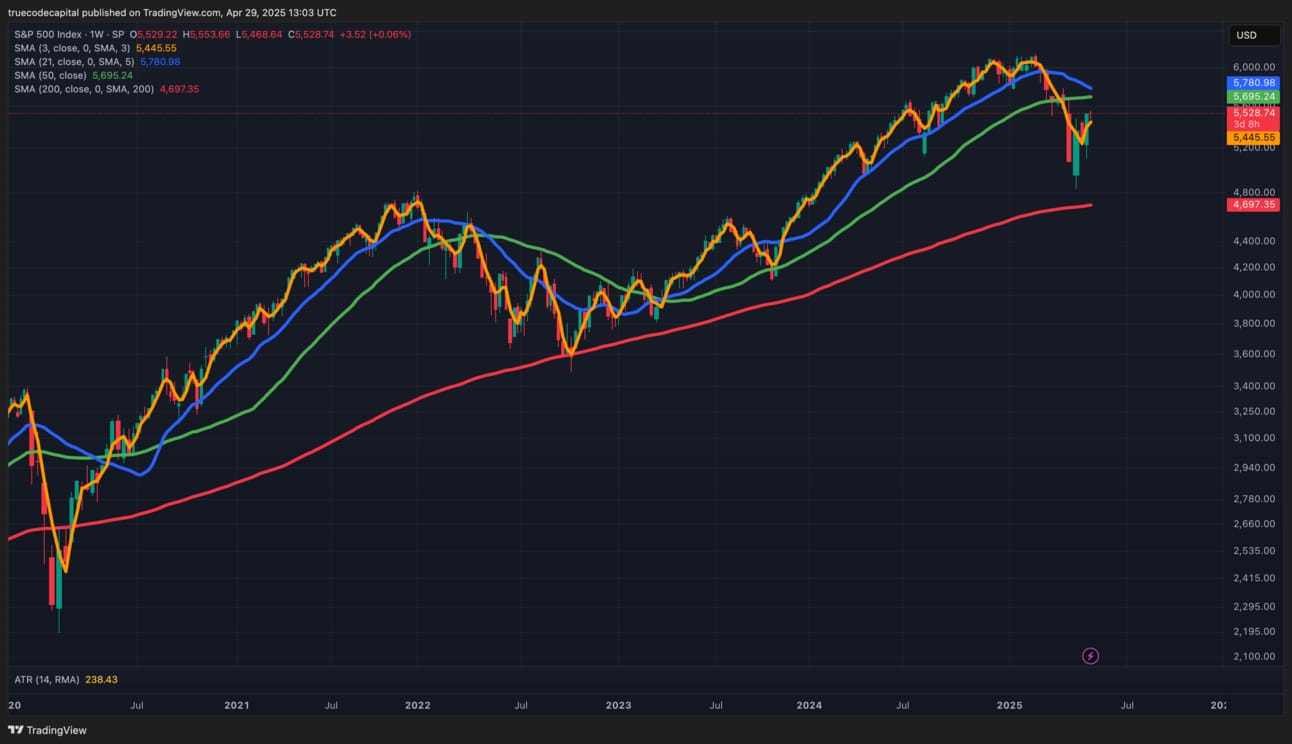
A Mixed Bag
The plusses and minuses in today’s market…
Today’s market is a bit curious.
No significant momentum to the upside or the downside.
I could make an equally compelling case for the bottom being in as for more pain to follow.
This week’s earnings have been a disappointment, but it doesn’t appear to affect the market maybe because everyone has already sold off.
So, let’s weight the evidence:
The Good
✅ The S&P 500 is staying above the Secular Bull Market 200-week indicator
✅ The S&P 500 has broken through the downtrend and held the 5,500 level
✅ Bitcoin is up signaling increased risk appetite
✅ Gold is leveling off
The Bad
❌ The market is still under a Death Cross on the daily chart
❌ A weekly Death Cross is coming nearer
❌ Overhead resistance at 5,700 on the weekly chart
This is one of those markets that could swing either way, or the most dreaded scenario: trade sideways for a while.
Sideways markets are my least favorite. I can never quite relax because I’m worried about the eventual plummet or whether I should be putting hedges on or taking them off.
For the moment, I remain hedged with my hedges coming off around 5600-5800, which coincides with the 20-week and 50-week moving average at the moment, so I’ll be watching those levels closely.
DEEP DIVE
The Hidden Flaw in Your Investment Strategy
Last month, a client called me after selling their business for $ 4.2 M. Their first question?
"Should I just put it all in VTI?"
A business gets sold.
A liquidity event happens.
Capital becomes available, often at the worst possible time.
Markets are near all-time highs. Valuations are stretched. Tech stocks dominate the headlines.
And yet, the conventional advice remains the same:
"Put it all in a low-cost index fund and hold."
That strategy works if contributions are made monthly for decades.
But the risk calculus changes when a large sum needs to be deployed at once.
A sudden 20–30% drawdown can permanently impair wealth.
That's not a theoretical risk—it's happened multiple times over the last two decades.
Listen, passive investing is not broken.
But it was built for a very specific investor profile: one earning a paycheck, contributing slowly, and retiring 30 years from now.
It was not designed for high-stakes, lump-sum deployment.
And there's another problem—one most retail investors miss.
The S&P 500, often praised as the gold standard of diversification, is anything but.
Despite holding 500 companies, the index is heavily concentrated.
Apple alone accounts for 6.6% of the total weight. The top 10 holdings make up 34.3% of the index, and nearly all of them are tech firms. When those names falter, the entire index suffers.
This is not diversification.
This is exposure disguised as safety.
Why Smart Beta Matters for Wealth Preservation
So, what are institutions doing differently? University endowments, pension funds, and wealth managers with billions under advisement aren't buying the S&P 500 and hoping for the best.
They're using something else entirely: factor-based investing known as smart beta.
Smart beta isn't marketing hype (though some treat it that way). It's a structured approach to avoid the flaws of market-cap weighting. Rather than allocating based on company size, smart beta strategies target specific performance drivers like:
Value: Companies trading below their intrinsic worth
Momentum: Stocks demonstrating sustained outperformance
Low Volatility: Assets with smoother price behavior
Quality: Strong balance sheets, consistent earnings, high ROIC
During the 2020 COVID crash, the USMV Low Volatility ETF fell just 18% compared to the S&P 500's 34% decline, protecting millions in capital for investors who had recently sold businesses or received inheritances.
These portfolios still look like "index funds" on the surface—many are structured as ETFs with low fees and good liquidity. But under the hood, the design is fundamentally different.
Drawdowns are typically lower.
Concentration risk is reduced.
And exposure to overvalued mega-cap tech is minimized.
Most major brokerages offer smart beta ETFs with expense ratios below 0.3%, comparable to standard index funds but with the structural advantages described above.
Smart beta sits in a middle ground: more sophisticated than pure passive investing, less expensive and less noisy than traditional active management.
Over time, performance has varied. Some smart beta strategies have underperformed market-cap indexes by ~1% annually. Others, especially value and low-volatility strategies, have outperformed during periods of market stress.
But the value isn't just in returns. It's in control. It's in risk management and aligning strategy with the reality of today's markets.
Because the real risk isn't short-term underperformance.
It's deploying serious capital into an overvalued, overconcentrated index and hoping the timing is right.
Markets may continue upward. Or volatility may return. Either way, capital deserves a structure that considers both.
Smart beta isn't just an academic concept—it's a practical shield against today's market extremes, designed specifically for wealth preservation when it matters most.
P.S. If you’d like us to break down your portfolio or ask a question, submit yours here: https://shrewdinvestor.com/roastme
If you are interested in sponsoring a future issue, send an email to: [email protected]
How do you like this sectionof this month's issue? |
The content provided in this newsletter is for informational purposes only and should not be considered as specific advice for any specific individual. The information is prepared by knowledgeable individuals and is not written by certified tax professionals or investment advisors. For personalized advice tailored to your unique financial situation, consult with a qualified tax professional, financial advisor, or attorney.
STILL WANT MORE?
How to Get a Deep Dive?
Want honest feedback on your investment strategy? Submit your portfolio or question to Shrewd Investor and get expert insights in our weekly 'DEEP DIVE' feature.
Ready for More Shrewd Investor?
Join us on Friday’s at noon MT for our weekly office hours, where we’ll discuss strategies like these…
👉 Reply with the words OFFICE HOURS to get the link…
How was the newsletter? |