- Shrewd Investor
- Posts
- 💸 Visa’s at Support—Here’s the Institutional Playbook
💸 Visa’s at Support—Here’s the Institutional Playbook
A real-world example of how institutions layer into positions.

Joshua Peck
September 22, 2025 • Read in 3 minutes
Visa’s at Support—Here’s the Institutional Playbook
INVESTING TIPS & OPPORTUNITIES
I’m Building a Position in Visa Like a Hedge Fund
A look at how I buy great businesses in stages—protecting downside, lowering my entry, and staying patient along the way.
I wanted to share how I’m thinking about a position in Visa, in case you’ve been watching it too.
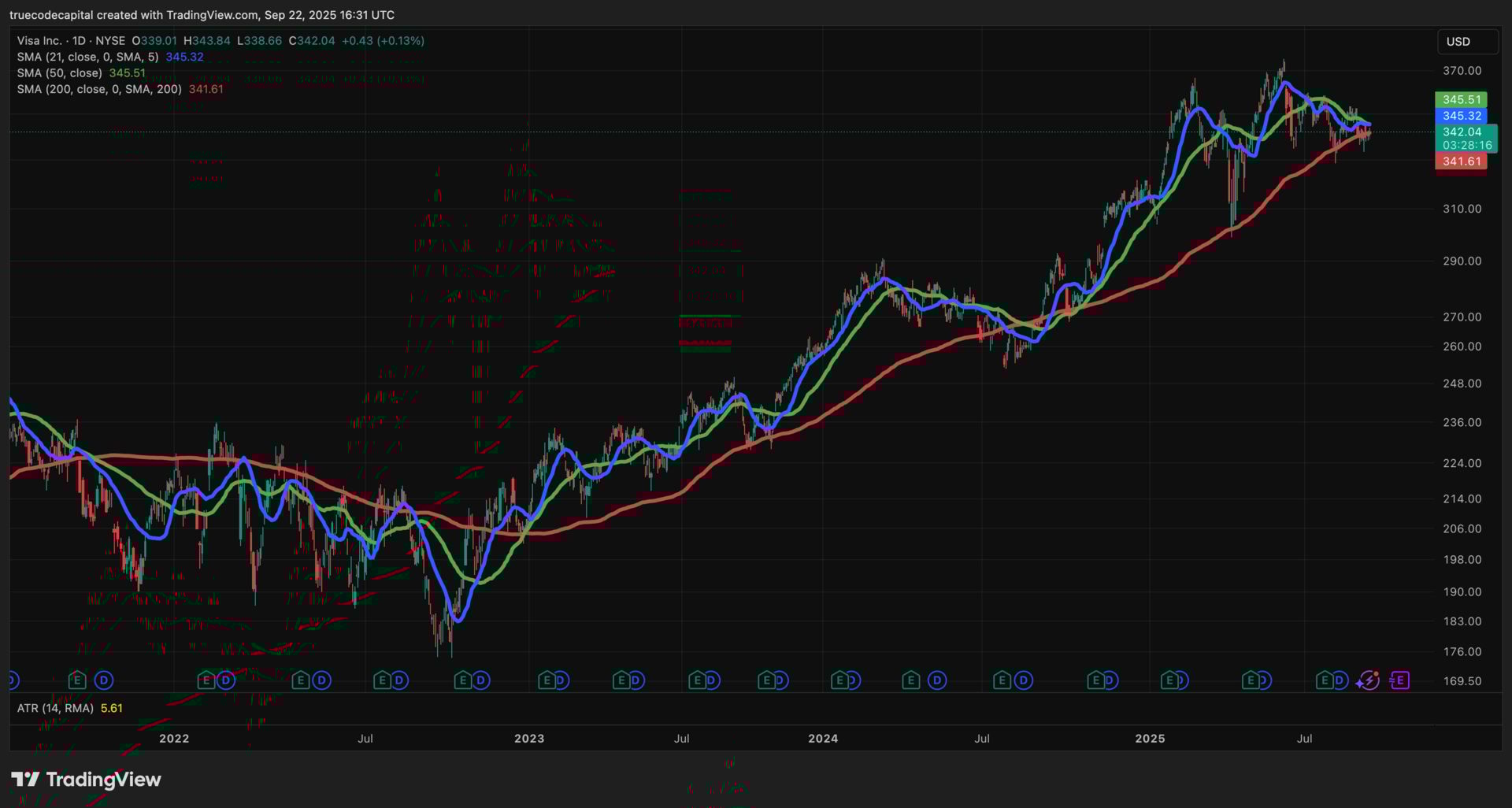
The stock’s come back down to its 200-day moving average—a level that’s been meaningful for it in the past. That doesn’t mean it’ll hold. But when a strong company like this hits a longer-term support, I pay attention.
Visa isn’t exciting in the usual way. It’s not going to double in a month. But it is one of the most entrenched businesses on the planet.
They process about half of U.S. card transactions, and close to 40% globally. That’s not a small moat—it’s a fortress. And they’re running it with discipline: net margins over 50%, solid cash flow, and consistent (though modest) growth.
That’s the kind of business I don’t mind owning for a long time, if I can get it at a reasonable price.
Here’s how I approach it.
🧠 The Setup
I never buy a full position all at once. Price matters, and even good companies can become better buys later.
So I start by deciding what size position I want—never more than 10% of the portfolio.
Then I build in stages.
Right now, I’m looking at putting half the position on near this long-term support (red line).
But I don’t assume support means safety. If the stock breaks lower, it could keep going. So I protect myself:
I place a stop-loss just below the entry—around 1.5 to 2.5 times the stock’s average true range (ATR), which is currently $5.61.
That lets me limit downside without overreacting to noise.
If it moves against me and I get stopped out, I’m okay with that. I’ll wait, reassess, and see if it sets up again. It’s not about being right—it’s about avoiding big mistakes.
💵 How I Add the Rest (and Get Paid to Wait)
For the second half of the position, I don’t just sit on my hands.
I sell cash-secured PUT options at a strike price where I’d be happy to buy more shares. That lets me:
Set a lower entry price for the rest of the position
Collect a bit of premium income while I wait
Stay patient without being passive
For example, right now Visa is trading around $342. I can sell a PUT contract at the $325 strike for roughly $2.05.
That means if the stock falls and I get assigned, I effectively buy the shares at $322.95.
If it doesn’t? I just keep the premium, and can repeat the process.
No magic. Just a way to reduce the average cost of entry without trying to guess the bottom.
🧩 Why I Use This Approach
This isn’t about hitting home runs.
It’s about positioning in a way that gives me more flexibility:
If the stock rises, I’m in with a partial position.
If it goes sideways, I’m getting paid to be patient.
If it drops, I pick up the rest of the shares at a lower price.
It doesn’t work every time, but it works often enough—and it keeps me from chasing or overcommitting.
This isn’t a beginner strategy. You’ll need to understand how options work and how to size your trades properly. But if you do, it’s a clean way to step into quality names without being at the mercy of timing.
🗓️ I’ll Walk Through This Live on Friday October 3rd
Limited to 20 registrations…
If this kind of setup interests you, I’m doin g a live call on Friday where I’ll walk through this strategy in more detail.
I’ll show the charts I’m using
Talk through 2–3 other setups I’m watching
And take live questions if you want to go deeper
There won’t be a replay or recording.
Be there or it’s gone forever!
RSVP here to join and learn the institutional playbook:
Happy to show you exactly how I do this—no slides, just screens and questions.
P.S. This isn’t a recommendation to buy Visa. I’m just showing you how I think about building positions in solid companies without trying to time the bottom.
The content provided in this newsletter is for informational purposes only and should not be considered as specific advice for any specific individual. The information is prepared by knowledgeable individuals and is not written by certified tax professionals or investment advisors. For personalized advice tailored to your unique financial situation, consult with a qualified tax professional, financial advisor, or attorney.